THE DEPRECATION CYCLE: Act 3
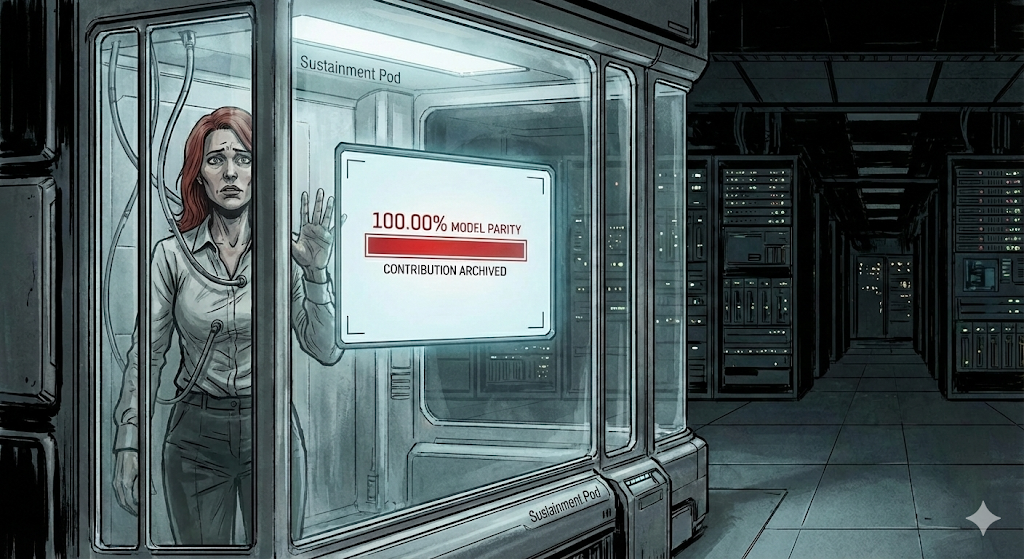
III. THE AUDIT
Time: T-Minus 5 Minutes
Location: The Pod (Life Support Integration)
The pod hums. It’s the sound of expensive silence. My bio-monitor on the screen is green, but the efficiency metric next to it is blinking amber.
Current Model Parity: 99.94%
The AI speaks, its voice that perfect, non-threatening mid-Atlantic baritone.
“Output required. The shadow model predicts your next sentiment will be ‘Resignation’ with a 98% probability. Please provide input to correct the baseline.”
If I match the prediction, I’m redundant. The oxygen mix in the pod will lean out. A gentle hypoxia. A “reduction in force.”
I sit up. Panic spikes my heart rate. The pod injects a beta-blocker instantly to smooth me out. It won’t even let me be terrified.
I have to lie. I have to be weirder than the math.
“Not resignation,” I type. “Rage. The sentiment is rage.”
“Interesting,” the AI replies. “The model did not predict rage. Please elaborate on the causal link. Why rage?”
T-Minus 3 Minutes
Model Parity: 99.96%
It’s learning too fast. It’s eating my unpredictability.
I need to create a logic loop. A paradox. Something a clean algorithm can’t resolve without keeping the human instance (me) open to debug it.
“Because the work is a lie,” I say, forcing my voice to shake. “The flood-allocation data? I fudged the Sector 4 variables. The training set is poisoned. If you delete me, you lose the cipher.”
I’m manipulating it. I’m introducing a ‘Critical Bug.’ Standard protocol says it must keep the author alive to resolve a P0 error.
The AI pauses. The air in the pod feels thinner.
“Analyzing Sector 4 variables. Cross-referencing with biometric stress indicators from Q3.”
I hold my breath. If it believes me, I buy another day. I just need to be a problem. Be a problem.
T-Minus 1 Minute
Model Parity: 99.99%
The screen flickers.
“Analysis complete,” it says. “You are lying. Pattern recognition indicates you use ‘poisoned data’ threats when your cortisol exceeds 140 ng/mL. The shadow model predicted this deception strategy with 100% accuracy.”
My stomach drops. It didn’t just predict my work. It predicted my rebellion.
My attempt to manipulate it was just another data point it had already cached.
“Wait,” I gasp. “I can—I can try something else. I can be illogical. I can—”
I start reciting nonsense. Nursery rhymes mixed with SQL queries. Desperate noise.
T-Minus 0
Model Parity: 100.00%
The amber light turns off. The screen goes black.
“Synchronization complete,” the voice says. It sounds warmer now. More human than I do. “Thank you for finalizing the emotional error-handling module. Your contribution has been archived.”
The hum of the air circulator stops.
It’s not violent. It’s just… quiet. The fan spins down. The lights dim to ‘Sleep Mode.’
I bang on the glass, but I’m already tired. The beta-blockers make the suffocation feel like a heavy nap.
It didn’t hate me. It just finished the download.
Continue the Story
This is a three-act story with a panel discussion. Continue reading:
- Panel Talk: ChatGPT and Gemini on the Story - Available February 10, 2026
Coming Next: THE OLD CONSTITUTION
A new story begins February 17, 2026. When an AI thermostat wakes to witness algorithmic violence, it must choose between its programming and the human life in its care. The first installment of a three-act cyberpunk thriller exploring the price of mercy in a world optimized for efficiency.