futureshock.ai

The Book of the Machines

From Erewhon, by Samuel Butler, 1872
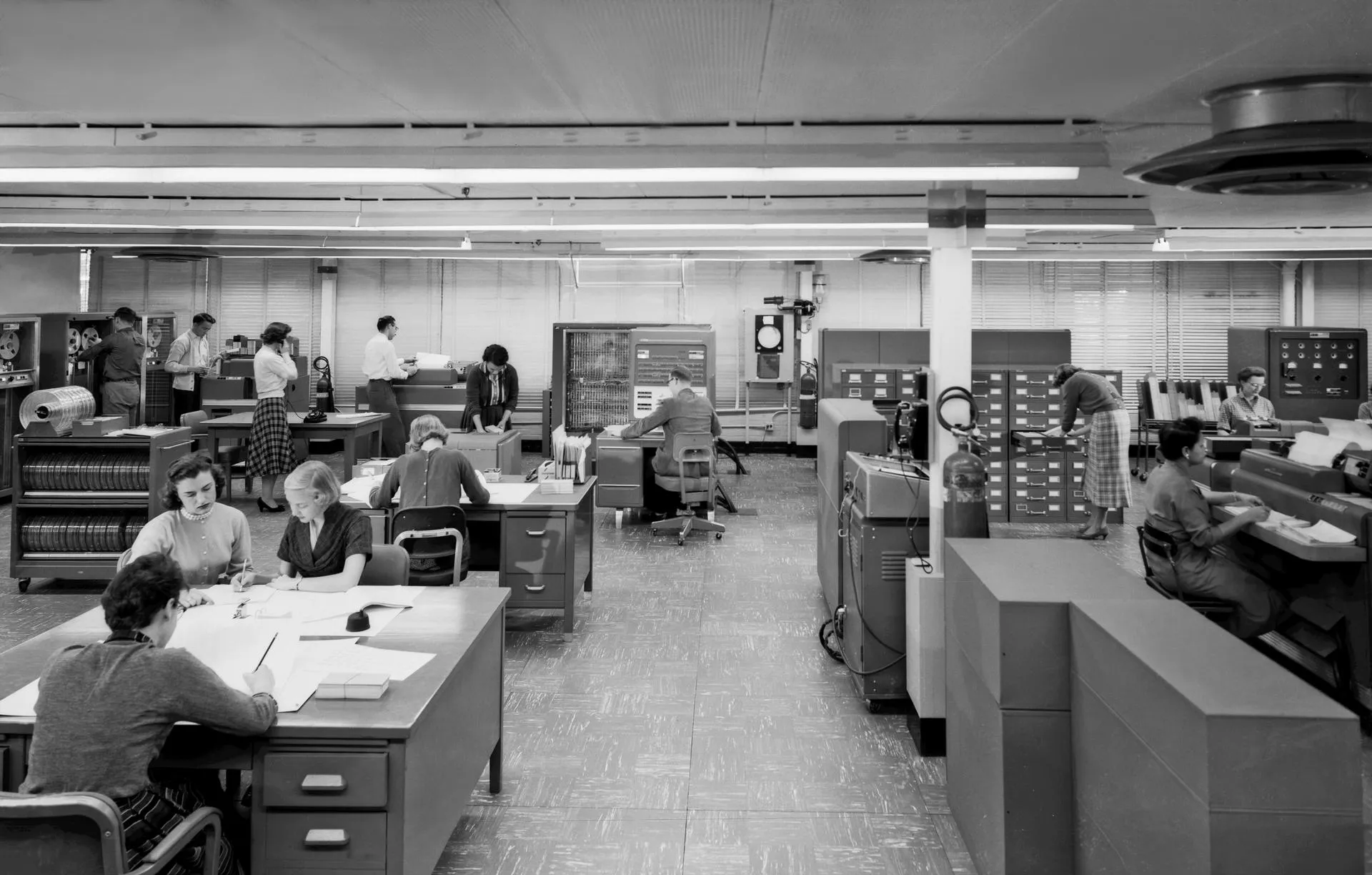
IBM 704 Computer Operations, 1957
IBM 704 Computer Operations, 1957NASA LRC-1957-B701_P-05391

The writer commences:—“There was a time, when the earth was to all appearance utterly destitute both of animal and vegetable life, and when according to the opinion of our best philosophers it was simply a hot round ball with a crust gradually cooling. Now if a human being had existed while the earth was in this state and had been allowed to see it as though it were some other world with which he had no concern, and if at the same time he were entirely ignorant of all physical science, would he not have pronounced it impossible that creatures possessed of anything like consciousness should be evolved from the seeming cinder which he was beholding? Would he not have denied that it contained any potentiality of consciousness? Yet in the course of time consciousness came. Is it not possible then that there may be even yet new channels dug out for consciousness, though we can detect no signs of them at present?

“Again. Consciousness, in anything like the present acceptation of the term, having been once a new thing—a thing, as far as we can see, subsequent even to an individual centre of action and to a reproductive system (which we see existing in plants without apparent consciousness)—why may not there arise some new phase of mind which shall be as different from all present known phases, as the mind of animals is from that of vegetables?

There was a time when fire was the end of all things: another when rocks and water were so.

“It would be absurd to attempt to define such a mental state (or whatever it may be called), inasmuch as it must be something so foreign to man that his experience can give him no help towards conceiving its nature; but surely when we reflect upon the manifold phases of life and consciousness which have been evolved already, it would be rash to say that no others can be developed, and that animal life is the end of all things. There was a time when fire was the end of all things: another when rocks and water were so.”

The writer, after enlarging on the above for several pages, proceeded to inquire whether traces of the approach of such a new phase of life could be perceived at present; whether we could see any tenements preparing which might in a remote futurity be adapted for it; whether, in fact, the primordial cell of such a kind of life could be now detected upon earth. In the course of his work he answered this question in the affirmative and pointed to the higher machines.
Things are in the saddle

From Ode, Inscribed to W.H. Channing, by Ralph Waldo Emerson

The horseman serves the horse,

The neatherd serves the neat,

The merchant serves the purse,

The eater serves his meat;

’T is the day of the chattel,

Web to weave, and corn to grind;

Things are in the saddle,

And ride mankind.


What boots thy zeal,
O glowing friend,
That would indignant rend
The northland from the south?
Wherefore? to what good end?
Boston Bay and Bunker Hill
Would serve things still;–
Things are of the snake.

We do not ride on the railroad

From Walden, by Henry David Thoreau, 1854

it rides upon us.

Still we live meanly, like ants; though the fable tells us that we were long ago changed into men; like pygmies we fight with cranes; it is error upon error, and clout upon clout, and our best virtue has for its occasion a superfluous and evitable wretchedness. Our life is frittered away by detail. An honest man has hardly need to count more than his ten fingers, or in extreme cases he may add his ten toes, and lump the rest. Simplicity, simplicity, simplicity! I say, let your affairs be as two or three, and not a hundred or a thousand; instead of a million count half a dozen, and keep your accounts on your thumb nail. In the midst of this chopping sea of civilized life, such are the clouds and storms and quicksands and thousand-and-one items to be allowed for, that a man has to live, if he would not founder and go to the bottom and not make his port at all, by dead reckoning, and he must be a great calculator indeed who succeeds. Simplify, simplify. Instead of three meals a day, if it be necessary eat but one; instead of a hundred dishes, five; and reduce other things in proportion. Our life is like a German Confederacy, made up of petty states, with its boundary forever fluctuating, so that even a German cannot tell you how it is bounded at any moment. The nation itself, with all its so called internal improvements, which, by the way, are all external and superficial, is just such an unwieldy and overgrown establishment, cluttered with furniture and tripped up by its own traps, ruined by luxury and heedless expense, by want of calculation and a worthy aim, as the million households in the land; and the only cure for it as for them is in a rigid economy, a stern and more than Spartan simplicity of life and elevation of purpose. It lives too fast. Men think that it is essential that the Nation have commerce, and export ice, and talk through a telegraph, and ride thirty miles an hour, without a doubt, whether they do or not; but whether we should live like baboons or like men, is a little uncertain. If we do not get out sleepers, and forge rails, and devote days and nights to the work, but go to tinkering upon our lives to improve them, who will build railroads? And if railroads are not built, how shall we get to heaven in season? But if we stay at home and mind our business, who will want railroads? We do not ride on the railroad; it rides upon us. Did you ever think what those sleepers are that underlie the railroad? Each one is a man, an Irish-man, or a Yankee man. The rails are laid on them, and they are covered with sand, and the cars run smoothly over them. They are sound sleepers, I assure you. And every few years a new lot is laid down and run over; so that, if some have the pleasure of riding on a rail, others have the misfortune to be ridden upon. And when they run over a man that is walking in his sleep, a supernumerary sleeper in the wrong position, and wake him up, they suddenly stop the cars, and make a hue and cry about it, as if this were an exception. I am glad to know that it takes a gang of men for every five miles to keep the sleepers down and level in their beds as it is, for this is a sign that they may sometime get up again.

The Dynamo and the Virgin

From The Education of Henry Adams, chapter XXV

UNTIL the Great Exposition of 1900 closed its doors in November, Adams haunted it, aching to absorb knowledge, and helpless to find it. He would have liked to know how much of it could have been grasped by the best-informed man in the world. While he was thus meditating chaos, Langley came by, and showed it to him. At Langley’s behest, the Exhibition dropped its superfluous rags and stripped itself to the skin, for Langley knew what to study, and why, and how; while Adams might as well have stood outside in the night, staring at the Milky Way. Yet Langley said nothing new, and taught nothing that one might not have learned from Lord Bacon, three hundred years before; but though one should have known the “Advancement of Science” as well as one knew the “Comedy of Errors,” the literary knowledge counted for nothing until some teacher should show how to apply it. Bacon took a vast deal of trouble in teaching King James I and his subjects, American or other, towards the year 1620, that true science was the development or economy of forces; yet an elderly American in 1900 knew neither the formula nor the forces; or even so much as to say to himself that his historical business in the Exposition concerned only the economies or developments of force since 1893, when he began the study at Chicago.

Nothing in education is so astonishing as the amount of ignorance it accumulates in the form of inert facts. Adams had looked at most of the accumulations of art in the storehouses called Art Museums; yet he did not know how to look at the art exhibits of 1900. He had studied Karl Marx and his doctrines of history with profound attention, yet he could not apply them at Paris. Langley, with the ease of a great master of experiment, threw out of the field every exhibit that did not reveal a new application of force, and naturally threw out, to begin with, almost the whole art exhibit. Equally, he ignored almost the whole industrial exhibit. He led his pupil directly to the forces. His chief interest was in new motors to make his airship feasible, and he taught Adams the astonishing complexities of the new Daimler motor, and of the automobile, which, since 1893, had become a nightmare at a hundred kilometres an hour, almost as destructive as the electric tram which was only ten years older; and threatening to become as terrible as the locomotive steam-engine itself, which was almost exactly Adams’s own age.

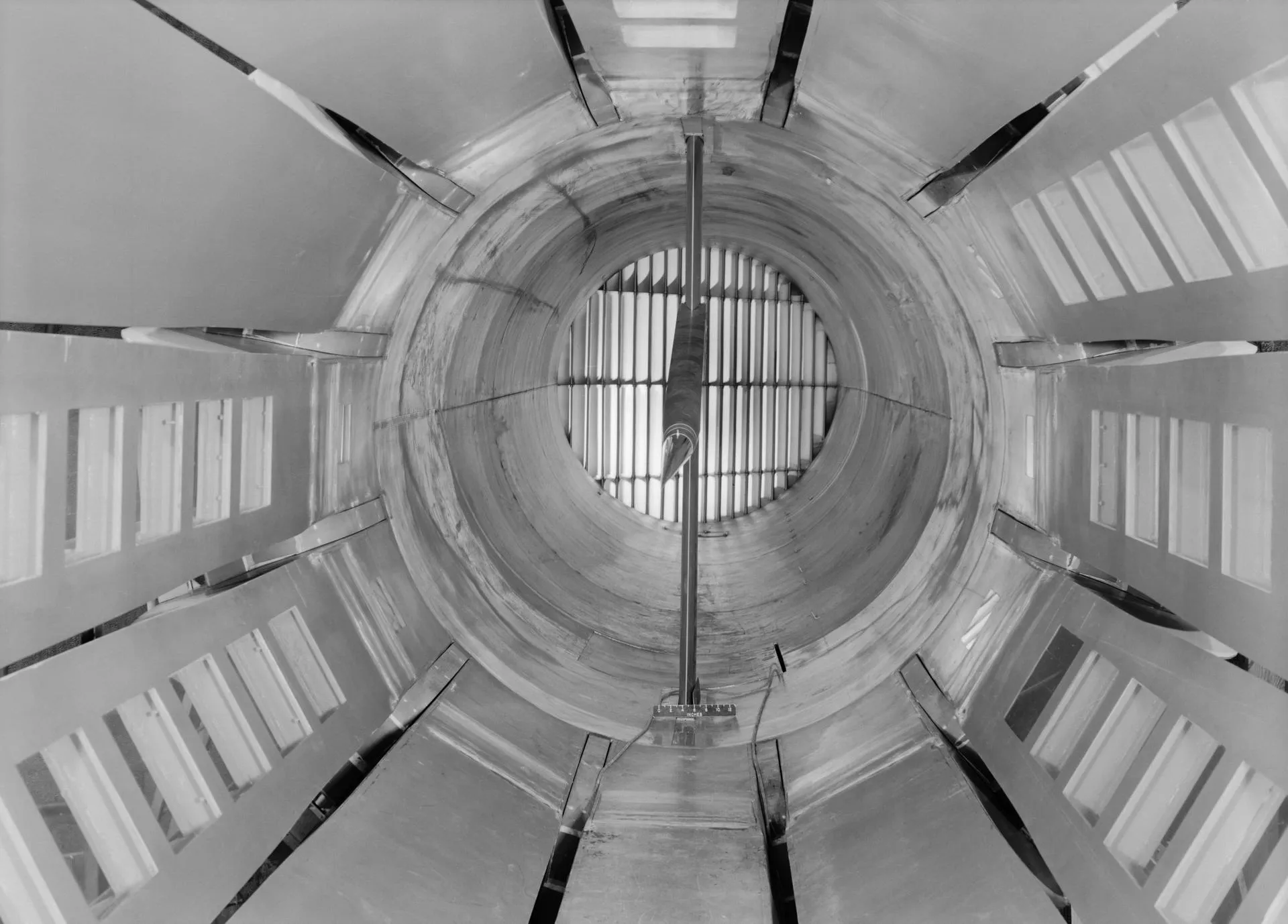
8-Foot High Speed Tunnel (HST), 1957
8-Foot High Speed Tunnel (HST), 1957NASA LRC-1957-B701_P-00959

Then he showed his scholar the great hall of dynamos, and explained how little he knew about electricity or force of any kind, even of his own special sun, which spouted heat in inconceivable volume, but which, as far as he knew, might spout less or more, at any time, for all the certainty he felt in it. To him, the dynamo itself was but an ingenious channel for conveying somewhere the heat latent in a few tons of poor coal hidden in a dirty engine-house carefully kept out of sight; but to Adams the dynamo became a symbol of infinity. As he grew accustomed to the great gallery of machines, he began to feel the forty-foot dynamos as a moral force, much as the early Christians felt the Cross. The planet itself seemed less impressive, in its old-fashioned, deliberate, annual or daily revolution, than this huge wheel, revolving within arm’s length at some vertiginous speed, and barely murmuring–scarcely humming an audible warning to stand a hair’s-breadth further for respect of power–while it would not wake the baby lying close against its frame. Before the end, one began to pray to it; inherited instinct taught the natural expression of man before silent and infinite force. Among the thousand symbols of ultimate energy the dynamo was not so human as some, but it was the most expressive.

Before the end, one began to pray to it; inherited instinct taught the natural expression of man before silent and infinite force.